
19th European Platform for Roma Inclusion focuses on education and employment [editar]
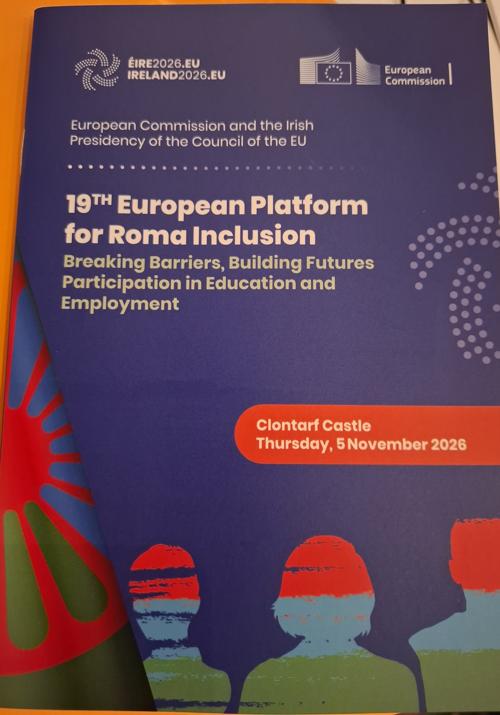
On 5 November, Dublin hosted the 19th European Platform for Roma Inclusion, under the theme “Breaking Barriers, Building Futures: Participation in Education and Employment”.
The European Platform is one of the main forums for dialogue and cooperation on policies promoting Roma equality, inclusion and participation in the European Union. Organised by the European Commission, it regularly brings together representatives of European institutions, national governments, international organisations and civil society to share experiences, review progress and address the main challenges that remain.
This year's event took place in Dublin during the Irish Presidency of the Council of the European Union, which runs throughout the second half of 2026 and is jointly organising the event with the European Commission.
Education and employment at the heart of the discussions
This year's edition focused on two key areas for advancing equal opportunities for Roma: education and employment. Particular attention was paid to the links between the two and the need for a comprehensive approach to tackling inequalities.
The Discussion Paper prepared for the Platform outlines some of the main achievements and challenges in these areas, drawing on several sources, including the findings of the EU Agency for Fundamental Rights (FRA) Roma Survey 2024.
The data show that, despite progress, significant inequalities remain. Only 32% of Roma young people aged 20–24 have completed at least upper secondary education, compared with 84% of the general population. In employment, 54% of Roma aged 20–64 are in paid work, a figure that falls to 38% among Roma women.
The paper also highlights the persistence of school segregation, discrimination and barriers to accessing quality employment. It emphasises the importance of developing policies that connect education, training and access to the labour market, with particular attention to Roma young people and women.
Among the initiatives highlighted is Fundación Secretariado Gitano's Acceder programme, presented as an example of an initiative aimed at improving skills and employment opportunities.
Sharing experiences and strengthening commitments to Roma inclusion
The event opened with contributions from representatives of Irish and European institutions, including Ana Carla Pereira, Director for Equality and Non-discrimination at the European Commission, and Martin Collins, Co-Director of Pavee Point Traveller and Roma Centre. A keynote address was also delivered by Michael O'Flaherty, Council of Europe Commissioner for Human Rights, focusing on equality, participation and inclusion for Roma and Traveller communities.
Throughout the morning, participants shared experiences and good practices from different European countries aimed at improving educational and employment opportunities for Roma. Government representatives from several countries, alongside civil society organisations such as ERGO Network, then discussed policy responses and the commitments needed to make further progress in these areas.
One of the central parts of the Platform was the participatory session “Every Voice at the Table”, organised around roundtable discussions that enabled direct exchanges between institutional representatives, civil society organisations and other participants. This format encouraged joint reflection on the barriers that continue to hinder equal opportunities for Roma, as well as the measures needed to improve their participation in education and employment.
The roundtable discussions also provided an opportunity to share experiences from different perspectives and put forward concrete proposals, highlighting the importance of ensuring that Roma communities themselves are involved in the design, implementation and monitoring of policies that affect them.
European funding and commitments to advance inclusion
The final session focused on the future of European funding and the measures needed to achieve sustainable progress in education and employment. Speakers included Patricia Bezunartea, Spain's Director-General for Family Diversity and Social Services; Eileen Flynn, a member of the Irish Senate; and Ana Carla Pereira, representing the European Commission.
The discussion took place at a particularly important time, with negotiations under way on the next Multiannual Financial Framework (2028–2034) and the development of future national and regional investment plans. In this context, participants addressed the importance of ensuring that EU funding continues to make an effective contribution to reducing the inequalities faced by Roma communities.
The Platform provided a further opportunity to strengthen dialogue between institutions and civil society on the implementation of the EU Roma Strategic Framework for Equality, Inclusion and Participation 2020–2030, highlighting the need to combine effective public policies, adequate funding and meaningful participation by Roma communities.
Gallery