

We present the barometer ‘The Social View of the Roma People in Spain’ [editar]
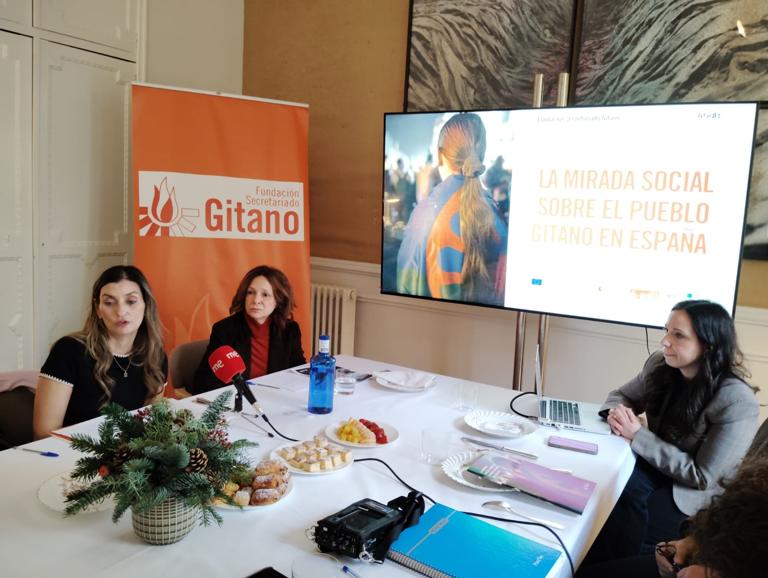
- Conducted in collaboration with the demoscopic company 40dB, for which 1 000 people in Spain were interviewed.
- The Roma population continues to be perceived as one of the most discriminated against groups, and at the same time as the one that generates the least personal sympathy. Furthermore, this rejection does not depend on ideology, but is transversal, which is not the case with other groups in the general population.
- Although very positive values of Roma culture are recognised, there are still perceptions that are far removed from the real situation (as evidenced by studies) of Roma people.
Coinciding with the 600th anniversary of the presence of the Roma people on the Iberian Peninsula and the government's declaration of the Year of the Roma People in Spain, Fundación Secretariado Gitano (FSG) today presented the barometer The Social View of the Roma People in Spain, the first study to comprehensively analyse how Spanish society perceives the Roma community and to what extent that perception corresponds to reality.
The report, prepared by the demoscopic company 40dB through a survey of 1 000 people, reveals that the Roma people in Spain continue to be one of the most discriminated against groups and, at the same time, one of the least known.
Profound ignorance about Roma history and culture
This barometer confirms that antigypsyism is widespread across the entire ideological spectrum. Respondents acknowledge the discrimination suffered by the Roma community, but also express one of the lowest levels of sympathy towards it. The data also reveals a profound lack of knowledge about Roma history and culture: 70.3% say they know little about it. Limited images centred on music and flamenco persist, while Roma people are rarely associated with science, business or senior positions in institutions.
Data versus beliefs
It also reveals areas where social perception is closer to reality, such as the recognition of Spanish citizenship for Roma people, the normalisation of their housing, and the discrimination they face in employment and housing. However, ideas that are far removed from official data persist: the high poverty rate is underestimated, dependence on social assistance is overestimated, and the belief that most Roma work in street vending remains. There are also doubts about the enrolment of Roma students in compulsory education, when in fact it is practically universal.
With regard to the perception of Roma women, most of those surveyed identify them as ‘traditional’, a view that obscures their diversity and their progress in education and employment. The study also points to the lack of daily contact between the Roma and non-Roma populations, a determining factor in the persistence of prejudice. Although the majority do not reject coexistence in spaces such as work or school, only 33% of people would not express any discomfort if their children had a Roma partner. On the other hand, more than half of the population perceives improvements in the situation of the Roma people over the last twenty years, but misconceptions about their relationship with education remain. Only 20% identify structural inequalities in the education system as part of the problem.
Stereotypical and prejudiced views are an obstacle to equality.
FSG's Director General, Sara Giménez, emphasised that this study 'comes at a symbolic but also decisive moment. After six centuries of shared history, the distorted view that much of society holds about the reality of the Roma people is deeply unfair. This stereotypical and prejudiced view is an obstacle to real equality and causes emotional harm to Roma. Changing this perception is essential.'
‘This barometer is an essential tool for understanding what mainstream society thinks about the Roma people today and for addressing the prejudices and stereotypes that weigh on the Roma population in a more realistic and appropriate manner,’ concluded Sara Giménez.
This barometer, developed within the framework of the IgualTrato project (Equal Treatment) financed by the European Social Fund Plus and co-financed by 0.7% grants from the Spanish Ministry of Social Rights, Consumer Affairs and Agenda 2030, aims to provide solid data to combat structural antgypsyism and promote evidence-based public policies. The next study will be published in 2029.
