
We are campaigning! [editar]
We at the FSG have started a new awareness-raising campaign: "Gitanos con Estudios, Gitanos con Futuro" ("Roma with Studies, Roma with a Future"). Here are the main arguments and the latest information on the campaign.
The FSG decided in 2009 to focus its main awareness-raising actions on education in the coming years. We thus launched the campaign “When I grow up I Want To Be...” in 2010/2011, with a view to raising the awareness of Roma families of the importance for their children of completing their secondary education, a campaign that received the recognition of the European Commission as "Good Practice" on two occasions.
In this academic year 2012/2013, we are taking a step forward by launching a new campaign aimed this time at teenagers, with the same objective: to encourage them to finish secondary education and to pursue their post-compulsory studies.
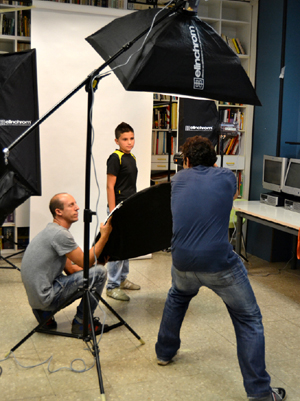
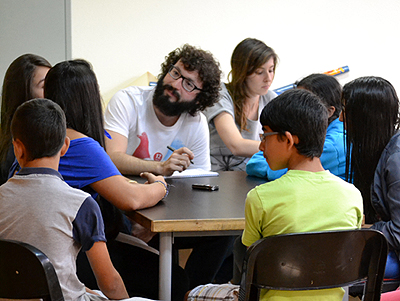
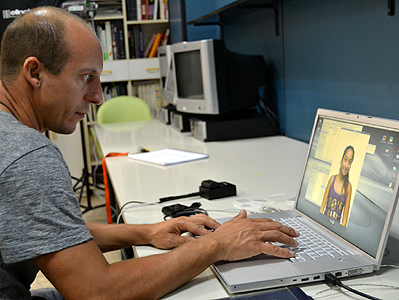
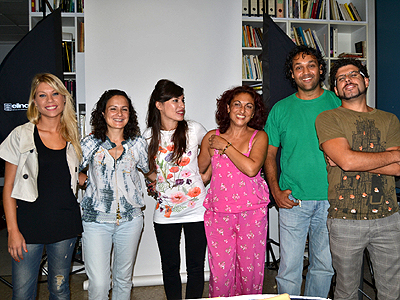
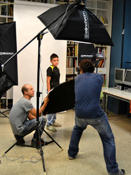
How do we raise the awareness of teenagers? Through street action in 14 Spanish cities, designed with the advertising agency Bassat Ogilvy. We called on teenage boys and girls to participate in a casting session; we set up group dynamics in order to know their dreams for the future and took portrait photographs of them on a photographic set. The castings took place in Valencia, Murcia, Albacete, Pamplona, Vitoria, Santander, Oviedo, Sabadell, Zaragoza, Valladolid, Madrid, Badajoz, Seville and Granada. The team of the Agency was actively involved in developing the casting that would certainly not have been possible without the previous notification and involvement of the staff of our FSG offices in those cities.
The casting turns on in a “small party” and participating in it was interpreted by Roma families as a reward and an acknowledgment of the teens. The participation in an advertisement casting also supposed an educational experience for these teenagers.
You can witness the process in more detail on the campaign's micro-site (available only in Spanish), which includes many photos of the protagonists of the campaign.
Two public presentations of the campaign followed in late 2012, one involving primarily the Roma teens and their families; and the other addressed to political and institutional representatives, opinion leaders, mass media etc, with the aim of increasing the impact of the campaign.
The campaign has different graphic and audiovisual expressions, which are available on its micro-site.
Gallery