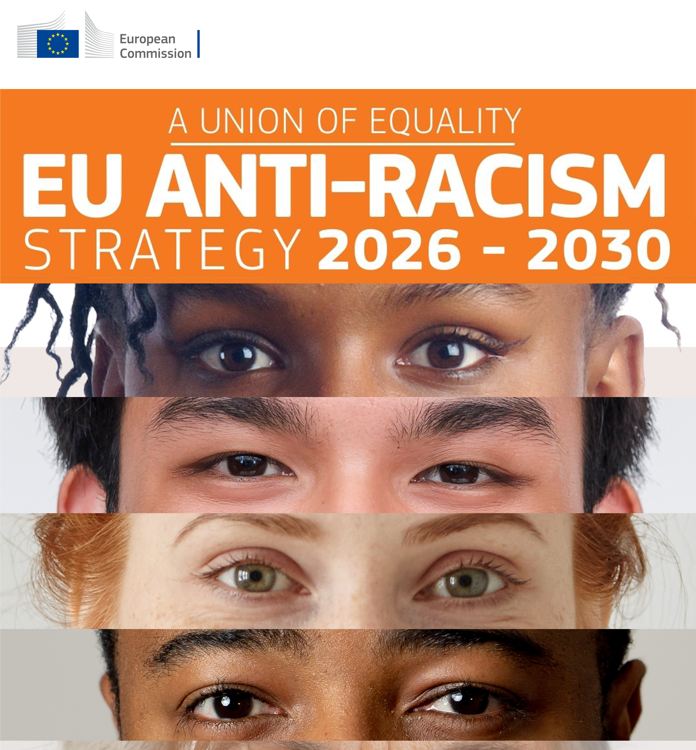

The European Commission publishes new Anti-Racism Strategy 2026-2030 [editar]

The document acknowledges that, despite progress in recent years, racism remains widespread in the EU: almost two out of three citizens perceive racial discrimination as a common phenomenon and Roma continue to be the group that suffers most from rejection in Europe.
On 20 January 2026 in Strasbourg, the European Commission presented the new Anti-Racism Strategy 2026-2030, a roadmap that aims to strengthen the Union’s commitment to a genuine Union of Equality.
The document acknowledges that, despite progress in recent years, racism remains widespread in the EU: almost two out of three citizens perceive racial discrimination as a common phenomenon and Roma continue to be the group that suffers most from rejection in Europe.
With this strategy, the Commission proposes a more ambitious and cross-cutting approach that aims to combine legislation, education, data, security, social policies and international cooperation.
The text is based on a central idea: racism not only manifests itself in isolated incidents, but operates as a structural phenomenon, accumulated over the life course, limiting access to education, housing, employment, health or justice.
To address this, the plan includes actions specifically aimed at combating specific forms such as antigypsyism, anti-black racism, anti-Semitism or anti-Muslim hatred, reinforcing already existing instruments such as the EU Roma Strategic Framework for equality, inclusion and participation.
The Commission will also take forward a joint educational project with UNESCO in 2026 to strengthen teaching on racism and human rights and launch a European awareness campaign on the Union of Equality.
The Strategy also announces a substantial improvement in data collection, an area where the lack of comparable indicators limits the design of effective policies. The Commission will publish a new Special Eurobarometer on discrimination in 2027 and work with Eurostat and the Fundamental Rights Agency (FRA) to expand and harmonise statistics on equality. The aim is to have more accurate information to understand how racism affects different groups and to measure actual progress over the coming years.
On legislation, Brussels is considering strengthening compliance with the Racial Equality Directive and exploring how to better sanction discrimination, including algorithmic discrimination. It also proposes to consider a legislative initiative harmonising definitions of online hate crime and recalls that the Digital Services Act (DSA) will be an essential pillar in curbing hate speech on digital platforms. The Commission will support Member States in training police, prosecutors and judges, and publish a compendium of best practices to prevent racial profiling in law enforcement.
The Strategy dedicates a central space to social equality, highlighting that racial discrimination has a direct impact on access to employment, education, housing and healthcare. The Commission will promote more inclusive educational environments, push for reforms that reduce school segregation (especially that affecting Roma students) and foster greater diversity in teachers. A European study on housing discrimination will also be published and a Council recommendation will be proposed to combat residential exclusion and homelessness. In health, the Commission encourages Member States to combat racial bias in medical care and to take advantage of EU programmes to improve the training of health workers.
The Strategy also underlines the importance of cooperation with civil society and the strengthening of the role of the European Coordinator on combating Racism, who will continue to lead the dialogue between authorities and affected communities. The Anti-Racism Civil Society Forum will be renewed and a new broader European platform will be enabled to protect civic space. In addition, the Commission will support Member States in developing national and local anti-racism plans, and strengthen collaboration with international bodies such as the United Nations and the Council of Europe.
With this strategy, the European Commission seeks to consolidate a lasting framework to combat racism in the next decade, with a vision combining respect for fundamental rights, social cohesion and economic competitiveness. The central message of the document is clear: a fairer, more inclusive and more democratic Europe will only be possible if racism is tackled in a coordinated and sustained manner.
Input from Fundación Secretariado Gitano and its reflection in the Strategy
The Strategy includes many of the contributions made by Fundación Secretariado Gitano (FSG) in the pre-consultation period. FSG proposed to create a specific chapter on antigypsyism and to recognise antigypsyism as a specific form of racism. The new Strategy, while not including a specific chapter, explicitly states that the Strategy combats all forms of racism, including antigypsyism. It includes references to the EU Roma Strategic Framework and the fight against antigypsyism as an obligation for Member States.
FSG proposed to improve the systematic collection of disaggregated data on discrimination and antigypsyism, to include specific questions in the Eurobarometer and to conduct comparable studies across countries. The Strategy includes a dedicated policy window: improving the collection, analysis and use of equality data, including data on racial/ethnic origin, announces a new Eurobarometer on discrimination in 2027, and a dedicated FRA study on the situation of Roma.
Regarding discrimination in employment, FSG proposed specific trainings for labour inspectors, employers and trade unions on antigypsyism, funding employment actions with the European Social Fund Plus and studies on discrimination in recruitment. The strategy includes measures for inclusive employment, combating discrimination in recruitment, and using the ESF + for inclusion and combating discrimination, a measure in which FSG is a pioneer with its IgualTrato (Equal Treatmen) programme and the Acceder programme in the field of employment.
On education, FSG called for measures against school segregation, teaching training and incorporating Roma history and antigypsyism into curricula. The strategy includes the creation of a European teachers’ agenda for diversity and inclusion, Erasmus+ and ESF+ programmes for educational inclusion, a project with UNESCO for anti-racism education in 2026 and explicitly mentions the situation of Roma students and the problem of segregation (it is indicated that one in two Roma children study in segregated schools).
Regarding the fight against hate speech and the implementation of the Digital Services Act (DSA), FSG called for the effective implementation of the DSA against hate speech and actions on means and self-regulation to curb anti-Roma stereotypes. The strategy includes the need for strict implementation of the DSA to combat illegal content and hate speech, and seminars and campaigns to counter racism in the media.
On hate crimes, FSG called for training for police, judges, prosecutors, specific measures against anti-Roma bias, and greater legal recognition of anti-Roma hatred. The strategy proposes more police and judicial training, a handbook of good practices to avoid discriminatory profiling, and strengthened rules against hate speech and a future European legislative framework on hate speech.
As regards housing, FSG proposed measures to eradicate slums, comprehensive urban policies and protection against discriminatory evictions. The strategy includes a European study on housing discrimination, the implementation of the European Recommendation against housing exclusion and the use of the ERDF and ESF+ for residential desegregation.
As regards the role of a Coordinator on combatting Racism, FSG proposed to strengthen the functions of that person. The strategy recognises the central role of the Coordinator in combating racism, expanding his/her role and fostering cooperation with other coordinators.
For all these reasons, FSG warmly welcomes this new strategy, especially since it takes up many of the contributions it made during the consultation period and because it reflects the situation of extreme vulnerability and discrimination still experienced by a significant proportion of the Roma in the European Union.
The Strategy is available at:
https://commission.europa.eu/document/f4acc4d4-689e-4db8-8c89-c7243b76ab88_en