

Improving Employment Services for the Roma communities [editar]
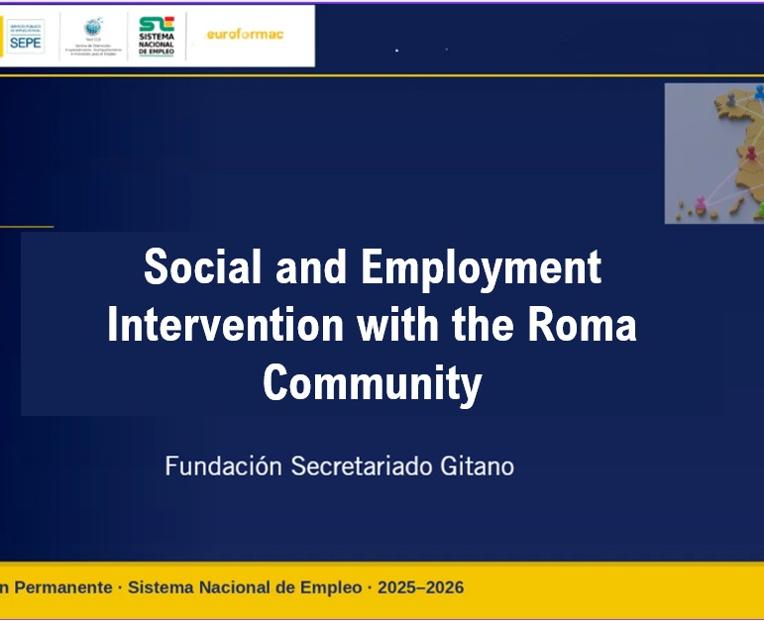
Together with the Spanish State Public Employment Service (SEPE), we are launching a new training programme to improve the employability of the Roma community
Last Monday, 22 June, saw the start of the training course ‘Social and Employment Intervention with the Roma Community’, delivered by professionals from the FSG, which will run until 26 July.
This initiative, in collaboration with the SEPE and Euroformac, forms part of the Action Plan to Improve the Employability of the Roma Community 2025–2028 and aims to provide specific, rigorous and specialised training to employment service professionals.
A total of 91 professionals from employment offices across Spain have enrolled, representing a diverse range of roles within the employment system: employment guidance, business liaison, employment training and support for entrepreneurship. Through a practical and participatory approach, the 37-hour course seeks to equip them with the tools to effectively address the improvement of the Roma employability.
The training began with the webinar “Addressing the Roma Question”, delivered by Ángel Pérez, head of the FSG’s Volunteering Department, which attracted a high level of participation. During the session, and in light of the participants’ widespread acknowledgement of a lack of prior specific training, the Roma history and its impact on the current situation were discussed.
Under the guiding principle: “We reflect, we do not judge”, the session analysed the stereotypes and prejudices which, within society and public administrations, continue to affect the Roma community and shape their relationship with employment. To conclude, the participants made a series of commitments, thereby marking a starting point towards a more conscious, transformative and committed approach.
Future sessions will address various key aspects of social and employment support for the Roma population. Topics to be covered include discrimination and antigypsyism, particularly in relation to access to employment; the situation of Roma women in Spain; and the nature of employment within the Roma community, with a particular focus on the role of street trading. Issues relating to intercultural understanding and mediation as tools to facilitate labour market inclusion will also be explored, as well as employment guidance strategies tailored to this population. Furthermore, ways of collaborating with companies to promote labour market inclusion will be analysed, and a practical activity will be carried out focusing on the design of a collaboration protocol between public employment services and specialised social organisations.
This training reinforces our commitment (and that of the SEPE) to more effective, inclusive intervention that is tailored to the realities of the Roma community.