
Every euro invested in the “Fight Against Discrimination” Operational Programme Returns €1.40 to society [editar]
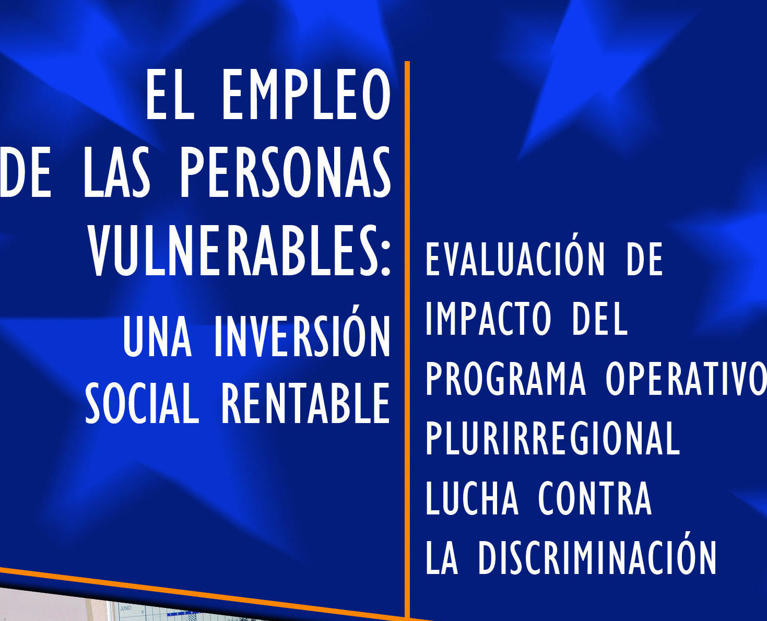
‘The employment of vulnerable people: a profitable social investment’ is an assessment of the impact of the OP between 2006 and 2011, carried out by the four private operators mentioned above in collaboration with the Ministry of Employment and Social Security, with co-financing from the European Social Fund, and which was presented last Friday at the headquarters of the European Economic and Social Council in Brussels.
(Madrid, 14 October 2013) - The Operational Programme to Combat Discrimination (OP), managed in Spain by 10 operators (including Fundación ONCE, Fundación Secretariado Gitano, Cáritas and the Red Cross), is an instrument co-financed by the European Social Fund that contributes to economic growth and social cohesion in Spain. Thanks to the actions of these operators and in close cooperation with the Spanish Ministry of Employment and Social Security, between 2006 and 2011, nearly 100,000 jobs were created in our country for people at risk of social exclusion.
This is the main conclusion of the study 'The employment of vulnerable people: a profitable social investment', which assesses the impact of the OP between 2006 and 2011. The study was carried out by the four private operators mentioned above in collaboration with the Ministry of Employment and Social Security, with co-financing from the European Social Fund, and was presented last Friday at the headquarters of the European Economic and Social Council in Brussels.
The document also concludes that the OP has been an important element in consolidating the welfare state and an effective instrument for social and labour inclusion, having created a total of 19,673 full-time annual contracts between 2006 and 2011 (5,167 direct and 14,673 indirect). In addition, it has contributed to reducing the public deficit by €23 million, thanks to an average increase of €39 million in public revenue.
Another conclusion of the study is that the PO is a factor in boosting the Spanish economy, as demonstrated by the fact that for every euro invested, production increases by €1.38. This represents an average saving of €9 million per replacement of non-contributory benefits with direct jobs.
In addition, for every euro invested in the OP, 91 cents are recovered through various types of tax returns, of which 59 cents correspond to the amount from the European Union, 8 cents from the Spanish public administrations and 25 cents from contributions made by the participating entities, which in turn implies a rate of return on national expenditure (measured by the ratio of total public revenue to national funding) of €2.55 per national euro invested (public and private).
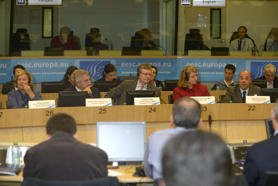
László Andor during the presentation
László Andor, Commissioner for Employment, Social Affairs and Inclusion, presented the study together with Gregorio Rodríguez Cabrero, Professor of Sociology at the University of Alcalá; Adriana Sukova-Tosheva, Director of the ESF for Spain; Lieve Fransen, Director-General for Social Policies at Europe 2020; and Miguel Ángel Cabra de Luna, as a member of the European Economic and Social Council.
Andor pointed out that the European Union redistributes 1% of European GDP, a figure intended to ensure that this social instrument is strong and effective: ‘Now more than ever, in the context of the current crisis, the ESF has a role to play in ensuring that citizens do not suffer the crisis to a greater extent.’
For the Commissioner, ‘the ESF can respond to new social challenges to help groups at risk of exclusion to integrate into the labour market’. In his opinion, the study presented today will help to improve a medium- and long-term strategy, and he is confident that ‘the Spanish experience will serve the rest of the member countries to make the labour market more accessible’.
For his part, Cabra de Luna stressed that the Operational Programme to Combat Discrimination ‘shows the human face of the European Union, which is even more important when it comes to people belonging to groups at risk of exclusion’. She called for the continuation of these programmes, recalling a Chinese proverb that says ‘a journey must begin with a first step, and the Operational Programme began in 2000. Let's not abandon it now’.
Adriana Sukova recalled that we are in a period of debate regarding the programming for the next period 2014-2020, ‘in which the key word is “smart inclusion” within the Europe 2020 Strategy, whose objective is to reduce poverty for twenty million people’.
Sociolaboral Inclusion
The OP has had a positive impact on social and labour inclusion. The number of jobs created between 2008 and 2011 grew by 18%. In other words, around 45% of intermediation actions have resulted in the creation of a job.
Job creation has mostly resulted in temporary jobs (around 85-90%), although contracts lasting more than one year have increased and currently exceed 20%. The study highlights that strengthening personalised pathways and work experience in training actions are two future challenges for strengthening the OP.
For the OP's managing bodies, innovation has been an important premise that has also enabled them to disseminate their best practices. From an impact perspective, the operating bodies have consolidated their collaboration, forming a stable network for training activities, methodological design, programme dissemination and raising awareness among civil society.
The future of the OP
The results of the study's evaluation justify the continuation of the OP, but the economic crisis and its repercussions require a redefinition of the objectives and methods of intervention in order to respond to processes of social and labour exclusion that are set to spread during the 2014-2020 programming period.
The study argues that the OP has a future and can contribute to the development of the objectives of the Social Cohesion policy for the next period 2014-2020 by implementing the Spanish Disability Strategy 2012-2020, the Strategy for the social inclusion of the Roma population in Spain 2012-2020 and the various plans for the integration of immigrants and those in situations of poverty and social exclusion.
On 23 October, this study will be presented in Madrid by Miguel Angel García Martín, Director General of Self-Employment, Social Economy and Corporate Social Responsibility.
Acceder and Promociona two success programmes
The Fundación Secretariado Gitano was represented by a delegation led by its director general, Isidro Rodríguez, who highlighted the importance of this report, which "confirms that investing in social inclusion is profitable from all points of view, because, in addition to having a direct impact on people‘ and ’the social transformation it brings about in the most disadvantaged, it also has an impact at the institutional level‘, ’since, ultimately, it clearly contributes to social cohesion and the improvement of our society‘. ’
For the director of the Fundación Secretariado Gitano, ‘although the outlook is bleak, what the Operational Programme to Combat Discrimination shows is that in these times of crisis, the organisations that develop the programme are serving as a protection and a cushion for the most vulnerable people’. Looking ahead to the future of the Programme, he stressed that ‘we hope that the European Commission will promote it for the next programming period and that the Spanish authorities will understand this, given the service it provides to Spanish society and the most disadvantaged’.
Acceder (training and employment) and Promociona (educational support) are two successful programmes run by the Fundación Secretariado Gitano throughout Spain and form part of this Operational Programme to Combat Discrimination, which is funded by the European Social Fund, numerous Spanish public administrations (state, regional and local) and an increasing number of private companies.
The Acceder vocational training and employment programme was launched in 2000 and since then has helped more than 70,000 people and secured more than 47,000 employment contracts. Between January and September 2013, it helped more than 12,000 people and secured 2,818 employment contracts.
The Promociona educational support programme, launched in 2009 and currently operating in 37 locations, worked with 1,182 students and 353 educational centres during the last school year.
Links
- El comisario europeo de Empleo presenta el estudio sobre el impacto del Programa Operativo de Lucha Contra la Discriminación
- La UE ayuda a la creación de 100.000 empleos para personas en riesgo de exclusión en España entre 2006 y 2011. Europa Press (11/10/2013)
- España crea 52.901 empleos gracias al Programa de Lucha contra la Discriminació. Servimedia (11/10/2013)
Gallery