
Education, employment and the fight against discrimination: priorities for the FSG [editar]
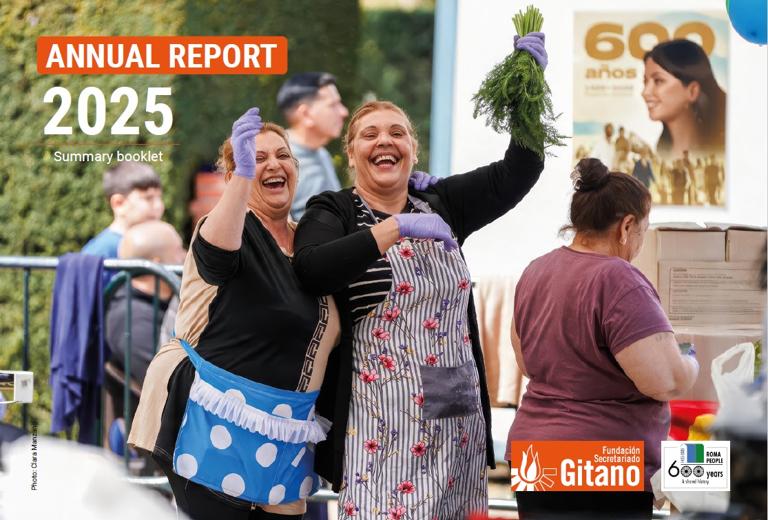
The 2025 Annual Report summarises the impact of our work on the lives of more than 40 000 people, in a year marking the 600th anniversary of the Roma community’s presence in Spain
Key figures from the programmes include the fact that 4 out of every 10 people on pathways for active job search found employment; nearly 5 900 students took part in compulsory and post-compulsory education; and nearly 1 200 victims of discrimination received support.
Fundación Secretariado Gitano (FSG) has presented its 2025 Annual Report, a year marked by the celebration of 600 years of documented presence of the Roma people in Spain and by intensive activity across 90 localities.
FSG is a nationwide NGO operating in 15 regions in Spain with 83 offices. In 2025, more than 40 000 people received direct support, and over 140 000 people took part in the more than 700 programmes we run in areas such as training and employment, education, housing, equality and the fight against discrimination, amongst others. Sara Giménez is the Director General and Jesús Loza is the President.
The FSG’s Annual Report is available online at https://www.gitanos.org/informeanual/ (in Spanish only), as a video and as a summary leaflet setting out the main results of our activities.
2025, a year of celebration marked by a high level of activity
2025 has been a year marked by the celebration of the 600th anniversary (declared by the government as the Year of the Roma People in Spain). It has been a year of significant activity and institutional commitment, complementing the advocacy and intervention work carried out by FSG. We took part in institutional events held at the Congress of Deputies (presided over by the Royal Family), the Government and the Ombudsman’s Office, amongst others, and we also organised a wide range of activities, mobilising our regional teams to celebrate with the Roma people, institutions and organisations with whom we collaborate.
In addition to marking this important anniversary, we would like to highlight our policy of strategic alliances; in 2025, we have signed agreements with prestigious organisations and institutions such as the General Council of the Judiciary, amongst others. In the context of public policy, we celebrate the approval of the Employment Plan for the Roma Community (the first public policy specifically aimed at the Roma community) which we hope will serve as a benchmark for other areas. Furthermore, this Plan draws inspiration from the initiatives that have been carried out for decades under the ESF+ programmes to promote employment amongst the Roma community.
When we approach the defence of rights through policy advocacy, the area of housing constitutes a fundamental pillar, and in 2025 we developed a comprehensive strategy in conjunction with the drafting of the State Housing Plan, to which we contributed through input and political dialogue at the highest level to achieve the ‘Zero Slums’ objective, as well as to the European Affordable Housing Plan.
In the field of social advocacy, and to understand the public’s perception of the Roma community and to influence it, we published a Social Image Barometer, a pioneering initiative in this field. We also collaborated with the CIS (Centre for Sociological Research), thanks to which several questions on public awareness of the history and culture of the Roma community have been included in its barometer.
We rounded off the year with the 8th edition of our ‘Dialogues for Interculturality’ conference, reaffirming the proposal we put forward on 8 April to promote a Comprehensive Law for the Recognition, Equality and Promotion of the Roma People
Access to employment: a priority for the inclusion of the Roma population
Through the vocational training and employment programme Acceder, recognised as the European initiative with the greatest impact on social and labour market inclusion for the Roma population, we supported 22 986 people in 2025, of whom nearly 5 000 secured employment and nearly 6 500 received training. Through Acceder, we collaborate with around 4 500 companies and address the specific needs of young people through dual training programmes in workplace settings such as Learning by Doing, Training with a Guarantee and TándEM, the latter in collaboration with the State Public Employment Service (SEPE). With an employment rate of around 38 per cent, more than 868 young people have taken part in these programmes this year.
For the educational success of Roma students
Education is one of our key priorities, both in terms of advocacy and intervention. That is why we continue to work through our educational support programmes and to call on the authorities to guarantee the right to education.
During the 2024/2025 academic year, we worked on our Promociona education programmes with 5 839 students, more than 4 249 families and 1 275 schools.
In the face of the dramatic school failure rates amongst Roma students, according to our latest study, the intervention by Promociona meant that, of the students in the 4th year of Compulsory Secondary Education, 216 obtained their certificates and, of these, 91 per cent went on to post-compulsory education. Of the students who were already in the final years of post-compulsory education, 189 obtained their certificates.
Combating discrimination, defending victims and strategic litigation
In the fight against discrimination, we assisted more than 1 233 victims of discrimination. We brought 19 strategic cases before the courts relating to antigypsyism and published the 21st Annual Report Discrimination and the Roma Community, in which we documented 399 cases of discrimination. We continued to coordinate the Assistance Service for Victims of Discrimination on the Grounds of Racial or Ethnic Origin, run by the Council for the Elimination of Racial or Ethnic Discrimination at the Ministry of Equality, alongside the 021 helpline for victims.
For the equality of Roma women
When we talk about Roma women, we must bear in mind that they face multiple barriers on their path to equality. That is why we mainstream gender across all our programmes and also run specific programmes, such as the Calí programme, which works nationwide with the most vulnerable Roma women.
Through Calí, we support the personal and social advancement, as well as the employability, of Roma women. In 2025, we supported nearly 1 700 women through personalised pathways and delivered 455 training sessions to raise awareness of gender equality, in which nearly 2 800 women and over 1 500 men took part. Last year, we supported nearly 120 women affected by gender-based violence. In the area of advocacy, we work to ensure that the specific circumstances of Roma women are incorporated into public policies; we did so for the State Pact against Gender-Based Violence, which includes specific measures and services for Roma women.
Initiatives to break the generational cycle of poverty
We supported more than 17 300 people through our social inclusion programmes. We worked with more than 13 000 families through the Basic Needs Support Service and provided support to more than 1 000 Roma families facing the greatest levels of exclusion to help them access decent housing. Through programmes funded by organisations such as the ‘la Caixa’ Foundation, we supported more than 3 800 children and their families who were lacking basic necessities relating to food, health and hygiene, whilst also providing educational support.
Social and political advocacy to defend rights
Throughout 2025, we have continued to make contributions and recommendations to the various legislative and policy initiatives promoted by regional and national public administrations, with the aim of ensuring that public policies also take into account the reality of the Roma community and serve to improve their living conditions.
This year, we have prioritised four key issues on which we have focused our political advocacy work: the European Union’s future Multiannual Financial Framework (2028–2034), which will have a significant impact on the European funds allocated to the social inclusion of the most vulnerable groups, including the Roma population; our proposal for a Comprehensive Act on the Recognition, Equality and Promotion of the Roma People; the drafting of the National Housing Plan, with the aim of making it an effective tool for the eradication of slums; and the right to education for Roma children.
We continue to participate in the European Commission’s consultative groups and to coordinate the European EURoma Network, in which 15 Member States and the European Commission take part.
Through the awareness-raising campaign The Zero.8, we highlighted the stark reality of the education system, in which only 0.8 per cent of Roma students graduate from university. Through this campaign, we called on the public authorities to address the dramatic figures relating to Roma students and to guarantee the right to education on an equal footing for Roma children and young people.
Once again this year, all our activities have been supported by the European Social Fund Plus; state and regional allocations from Income Tax and the 0.7 per cent grants for activities of general interest deemed to be of social interest; support from regional and local authorities; organisations such as the ‘la Caixa’ Foundation and companies such as Accenture, the Telefónica Foundation, the Mapfre Foundation and Deloitte, amongst many others, as well as partners and donors.