

A story of persecution and suffering [editar]
"I, Alfonso, to each and every one of my noble, beloved and faithful subjects, health and affection! As our devoted Juan of Little Egypt has permission to pass through our kingdoms and lands, we want him to be well treated and welcomed, so we command each and every one of you, under penalty of our wrath, that the aforementioned Juan of Little Egypt and those who accompany him be allowed to go and stay in any city, granting them safe passage when the aforementioned Don Juan so requires through this safe conduct"
Image: Safeconduct from Alfonso V of Aragon to Juan of Little Egypt , 1425
The coexistence of the Roma groups that crossed Europe was broken in Spain in 1499 when a series of laws or Pragmatics began to be enacted that sought to eradicate their culture.
From then on, more than 200 anti-Roma laws were enacted, some as recent as the one prohibiting the use of the Roma language, Caló, considered ‘criminal jargon’ during the Franco dictatorship. It was not until the 1978 Constitution that full equality for all Spaniards was recognised. This was the first time that Spanish law guaranteed coexistence and citizenship, with full rights for Roma.
Some anti-Roma laws
- 1499: Pragmatic of the Catholic Monarchs: Law that seeks to end the rights that had been granted to Roma as pilgrims and their distinct cultural behaviours (language, clothing, customs, etc.).
"We command the Egyptians who wander through our kingdoms and domains... to live by known trades... or take up residence with lords whom they serve... If they are found or caught without a trade, without lords, together... they shall be given one hundred lashes each for the first offence and banished perpetually from these kingdoms, and for the second offence their ears shall be cut off, and they shall be put in chains and banished as stated..."
- 1749: The Great Round-up. On 30 July 1749, Ferdinand VI orders the arrest of all Roma in the Kingdom: men, women, the elderly and children.
For serious reasons, which have made the audacity of those who call themselves Roma very notorious, since with the insolence of their perverse inclinations, their families have continually made themselves unwelcome in the designated neighbourhoods, His Majesty's pious justification was resolved, both for the relief of his people and to contain and amend once and for all this multitude of infamous and harmful people, and harmful, that all those who lived in these domains under the name and common opinion of Roma should be gathered together..." Royal Instruction of 28 October 1749, relating to the gathering of Roma.
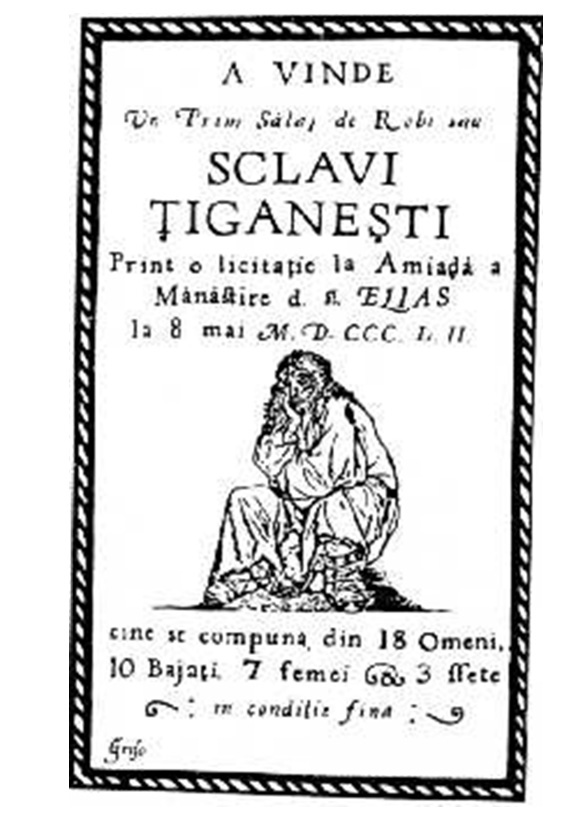
- 1864: Advertisement in a monastery in Wallachia (Romania) in the 19th century: ‘A good batch of Roma slaves for sale at the Monastery of St. Elias on 8 May 1852, consisting of 18 men, 10 boys, 7 women and three girls in good condition’. The enslavement of Roma continued in some regions of Romania until 1864.
- 1944: The Night of the Roma. The persecutions did not only affect Spanish Roma. In 1938, in Nazi Germany, the Porrajmos or Samudaripén (the Roma Holocaust) began, in which an estimated 500,000 Roma from various European countries were murdered in concentration camps. ‘The Night of the Roma (Zigeunernacht)’: the killing of some 4,200/4,300 Roma men and women on the night of 1-2 August 1944 in the Auschwitz-Birkenau concentration camp. Every year, the European commemoration of 2 August as Roma Holocaust Day gains momentum.